
Pre-orders are now open. Delivery begins in the fourth quarter of 2026. Pre-order
Potential module: the gold standard for corrosion diagnosis
As the core module of the BlueSpine multi-measurement system, potential measurement is the gold standard for diagnosing corrosion in reinforced concrete structures. It enables engineering firms and diagnostic specialists to detect corrosion activity, even in areas that appear sound. It highlights surface potential gradients generated by corrosion cells present in the reinforcing bars. These gradients result from the coexistence of steel that has been depassivated—by chlorides or carbonation—and steel that remains passive. The resulting map reveals corrosion activity zone by zone and guides the selection of concrete samples needed to confirm the defect. Designed by BlueSpine’s corrosion experts, this module brings their diagnostic methodology and high standards directly to the field.
Talk to an expert
Potential measurement to detect and locate corrosion activity
The electrochemical principle of potential measurement
When an area of steel is depassivated by chlorides or carbonation, it forms a galvanic coupling with the rest of the reinforcing steel that is still sound. A current then flows between this anodic zone and the surrounding cathodic zones.
This phenomenon creates a non-uniform potential field on the surface of the concrete. Potential mapping measures these variations point by point to locate areas of corrosion activity.
Key questions regarding potential measurement
How do you create and interpret a potential map?
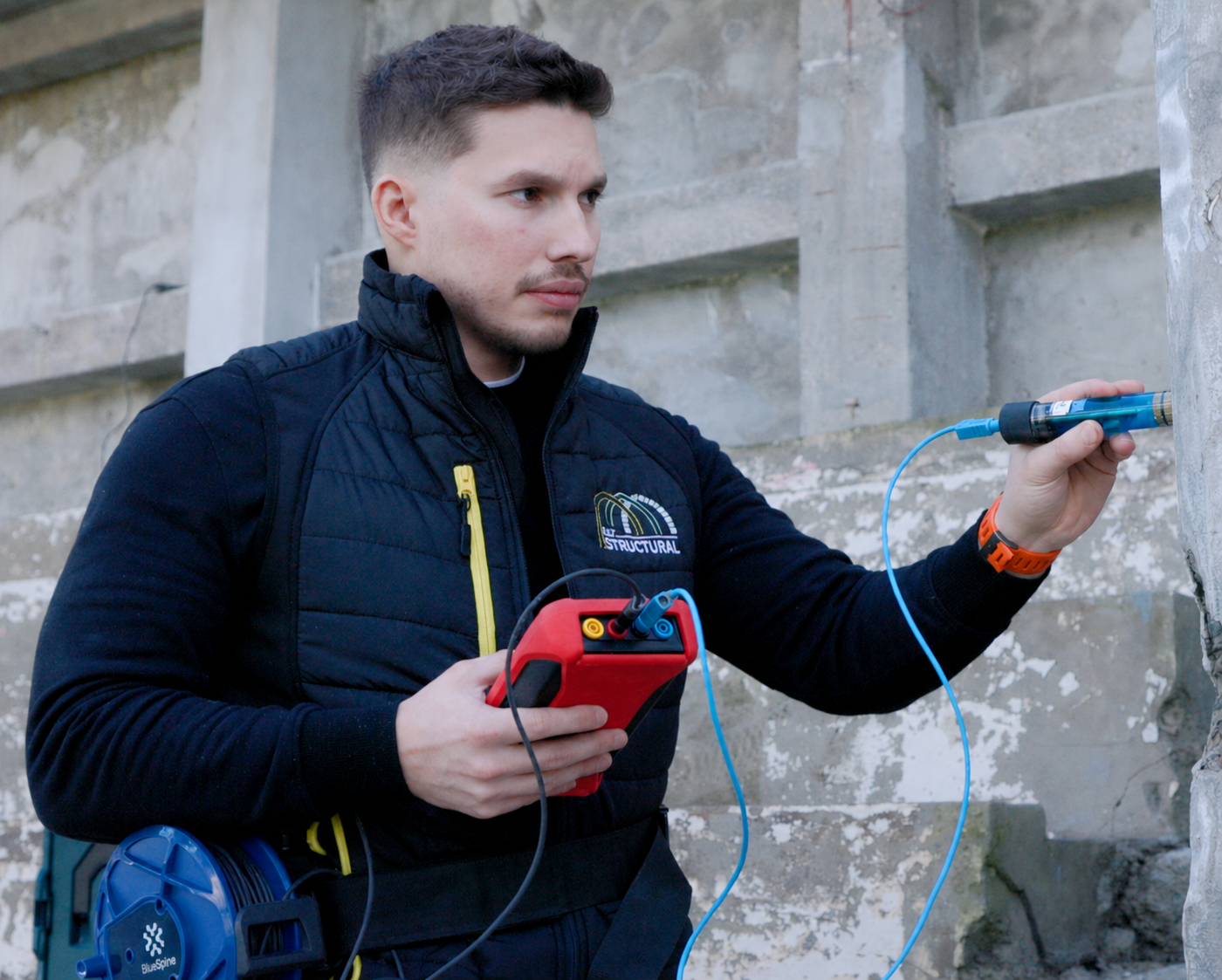
The measurement involves recording the potential difference between the steel and a reference electrode positioned on the surface of the concrete. Measurements are taken at regular intervals of 25 to 50 cm, in accordance with the recommendations of RILEM TC 154. The resulting map is interpreted based on the potential gradient: its amplitude is directly correlated with corrosion activity. The steeper the gradient, the greater the corrosion activity. Generally higher gradients are observed in the presence of chlorides than in the presence of carbonation.
Read moreWhy analyze the potential gradient rather than the absolute value?
The absolute value of the potential varies depending on the measurement conditions. Temperature, concrete moisture content, and contact resistance all influence the result. Interpretation therefore relies primarily on the local potential gradient, which is more stable and allows for the direct identification of the signature of a corrosion spot. The gradient also offers another advantage: it can be measured without making contact with the steel. On structures where drilling into the rebar is not feasible, a multi-electrode device can be used. This configuration is suitable for historic monuments, structures containing asbestos, ATEX zones, and nuclear sites. The gradient is then measured directly on the surface, point by point, without any destructive intervention.
Read moreHow does potential measurement guide the diagnosis?
Potential mapping guides the rest of the diagnostic process. It directs the diagnostician to the areas where concrete samples should be taken. These samples are taken directly at the corrosion sites, where the potential gradient is highest. They are also taken in areas with a low gradient, which are considered to be sound. In active areas, the analysis confirms the nature of the defect (carbonation, chlorides) and its degree of contamination, particularly to help determine the choice of cathodic protection technique. In areas that appear sound, comparing the depth of contamination with the cover depth of the reinforcing bars estimates the time remaining before corrosion begins in the most exposed reinforcing bars. Depending on the results, the area may be excluded from the scope of work, placed under monitoring with electrochemical sensors, or treated preventively if the level of contamination proves to be significant. Potential mapping and laboratory analysis of targeted samples are the two most critical elements in the set of indicators used to distinguish affected areas from those that are still intact.
Read moreEverything you need to know about corrosion diagnosis
OPERATING DIAGRAM
Features of the BlueSpine potential measurement module
Project mode
Manage your campaign zone by zone from the control unit. Each section of the structure is identified and monitored. The data collected is centralized in the database in real time.
Potential mapping
View the corrosion condition of the reinforcement as early as the on-site diagnostic stage: absolute values or values scaled to a reference defined by the operator, and a statistical distribution of the measured values in the form of a customizable histogram with adjustable intervals.
Gradient mapping
Identify areas of active corrosion without needing to connect to the rebar. The spatial potential gradient, calculated at each point, reveals what conventional potential mapping does not show.
Interactive ruler
Draw a line between two points on the map and instantly view the actual value of the potential gradient between them. Verification of a suspicious area is done in the field, without having to return to the office.
Pre-filled deliverable
The software built into the unit generates a pre-filled diagnostic report directly from the analysis of the structure. The inspector uses this pre-structured report and focuses on interpreting the results.
A multi-function unit designed to expand as the product line grows
Potential measurement is one of the features of the BlueSpine diagnostic unit. Designed for multi-parameter measurement, it connects to a set of specialized probes and incorporates a current injection source to perform active stress tests.
The unit comes standard with a 4-wire electrical continuity test for steel, as required by the EN ISO 12696 standard as a preliminary check prior to the installation of cathodic protection.
Additional probes will gradually expand this range of measurements (concrete resistivity, corrosion rate, impact hammer for guardrail diagnostics), all connected to the same unit and accompanied by an automatic update of the analysis software. Each additional probe enriches the set of indicators and further refines the scope of the corrosion diagnosis.
Technical characteristics of the BlueSpine potential measurement module
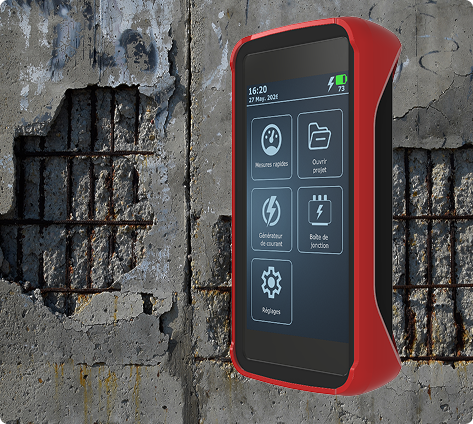
| Housing | Reinforced ABS, IP67 waterproof, 200 × 105 × 34 mm, belt clip |
| Screen | 5″ touchscreen, readable in direct sunlight |
| Power and Connectivity | USB-C charging (power bank compatible), 4 waterproof banana plugs |
| Potential Measurement | High impedance (10 MΩ) and very high impedance (1 GΩ), compatible with high-resistivity concretes (dry concrete, modern formulations incorporating blast furnace slag, etc.) |
| Potential mapping | Real-time display of acquired values, either as absolute values or scaled to a reference defined by the operator; surface distribution configurable by number of segments or by segment width (mV) |
| Gradient mapping | Calculation at each point of the spatial potential gradient (maximum difference between the value at that point and those of adjacent points, normalized by the sampling interval); generation of a dedicated map independent of the selected reference; manual plotting using an interactive ruler to read the gradient value along a selected segment |
| Multi-electrode mode | Gradient mapping without connection to the reinforcement, for structures containing asbestos, classified structures, or those in controlled zones |
| Continuity Test | 4-wire configuration compliant with EN ISO 12696 |
| Analysis Software | Project mode for zone-by-zone campaign management, centralized data collection, and generation of a pre-filled diagnostic report |
| Design and manufacturing | France |
The benefits of the BlueSpine potential measurement module
The BlueSpine potential measurement module is designed to ensure the success of your mapping campaigns by reducing uncertainties, speeding up data collection, and simplifying field analysis.
Accuracy and reliability
Potential measurement is an indirect measure of corrosion activity. It is subject to numerous fluctuations depending on the measurement conditions. Two operators using the same device and the same protocol may obtain different results at the same point. To ensure reliable and reproducible measurements, BlueSpine has incorporated a stability criterion based on two automatic checks: • a measurement at high (10 MΩ) and very high (1 GΩ) input impedance to detect parasitic contact resistance; • an analysis of the potential’s drift over time. When these two indicators agree, the measurement is validated. Otherwise, the operator is prompted to re-establish good electrolytic contact (by moistening the surface, using a sponge, or applying electrolytic gel) before repeating the measurement. Each point on the map is thus based on reliable data, regardless of the operator. This same requirement applies to the electrical continuity testing of steel. Performed with a multimeter at low current, the conventional method cannot distinguish between true metallic continuity and a false positive caused by the conductivity of wet concrete or capacitive coupling between adjacent reinforcing bars. By injecting current in accordance with EN ISO 12696, the BlueSpine unit eliminates this ambiguity and verifies with certainty the continuity of the reinforcement—a critical factor in the design of cathodic protection systems.
Read more Read lessProductivity on the construction site
The productivity of a mapping campaign depends on two factors: the time spent collecting data on-site and the time spent analyzing and documenting the data once back in the office. The most common practice in the field today involves using a multimeter, recording values by hand or even verbally, and then reconstructing the map in the office—a lengthy process prone to transcription errors. The potential measurement module of the BlueSpine diagnostic unit addresses both main phases of the campaign. 1. On-site, measurements are acquired automatically. An initial level of real-time analysis guides the operator on where to take samples and supports on-site intervention decisions. 2. Back at the office, the analysis software processes the acquired data to perform further analysis (calibration relative to the reference electrode, adjustment of colorimetric thresholds, cross-referencing with results from physical samples) and generates a report that is already processed and ready for finalization.
Read more Read lessField ergonomics
Integrated into the diagnostic unit, the steel potential measurement module shares its ergonomic design: IP67 waterproof, shock-resistant, and resistant to temperature fluctuations, and rechargeable via a power bank during field operations. The unit can be operated with one hand, worn on a belt, and features a touchscreen that is readable in direct sunlight, allowing users to view maps directly in the field.
BlueSpine's expertise at your fingertips
The diagnostic unit is part of a comprehensive ecosystem.
The multi-measurement unit does more than just collect data. All measurements taken (potentials, gradients, and—eventually—corrosion rate, resistivity, etc.) are cross-referenced in the BlueSpine analysis software with structural survey data (concrete cover measured by radar or pacometer) and pollution depths (chlorides, carbonation).
The software draws on scientific literature, current technical guidelines, and assessments conducted by BlueSpine on dozens of structures. It identifies correlations among these different datasets to generate actionable insights: corrosion type, location of active corrosion sites, and estimated remaining service life.
As the database grows, these correlations become more accurate. The software thus builds on the experience gained from each structure that has been assessed.
Comparison chart
Compare the characteristics of the standard hardware with those of the BlueSpine module to assess your project’s needs.
| Characteristic | Standard Equipment | BlueSpine Module |
|---|---|---|
| Gradient mapping and evaluation of the local gradient between two points | ✗ | ✓ |
| Gradient mapping without connection to rebar (multi-electrode) | ✗ | ✓ |
| Very high impedance measurement (1 GΩ) for resistive concrete | ✗ | ✓ |
| 4-wire continuity test compliant with EN ISO 12696 | ✗ | ✓ |
| Analysis software and pre-filled diagnostic report | ✗ | ✓ |
| A single device replaces multiple measuring instruments | ✗ | ✓ |
| Automatic stability criteria for potential measurements | ✗ | ✓ |
A ready-to-use specimen collection kit
All the equipment and supplies needed for a field campaign in a single kit
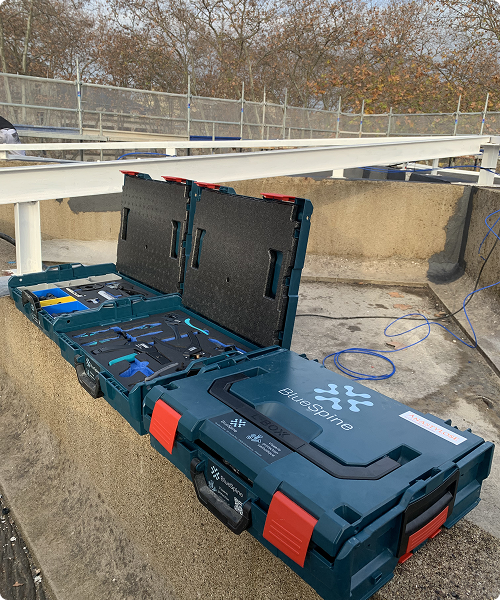
The sampling kit contains all the equipment needed for diagnostic field campaigns. It includes:
- the reference electrode for potential measurements
- cabling and accessories for characterizing concrete contamination
- a thymolphthalein spray for carbonation testing
- a distilled water spray for potential measurements
- vials for collecting powder samples for laboratory analysis of chloride content
The entire set is housed in an ABS L-Boxx case, designed to withstand the most demanding conditions on construction sites.
| Component | Description |
|---|---|
| Reference electrode | 2 Cu/CuSO₄ electrodes, to be connected to the housing for measuring steel potentials |
| Wiring | Banana plugs and alligator clips |
| Carbonation kit | Thymolphthalein spray for carbonation testing on fresh fractures |
| Chloride vials | Vials for sampling and laboratory analysis of chloride content (free/total) |
| Transport case | Impact-resistant ABS L-Boxx case, sized for real-world job site conditions |
Request a quote
Q&A
Your questions, our answers
Why measure the potential gradient rather than just the absolute potential?
The absolute potential depends on the reference electrode used and remains sensitive to measurement conditions (surface moisture, quality of the electrolytic contact, temperature). The spatial gradient of the potential—calculated at each point as the maximum difference between the value measured at that point and those at adjacent points, relative to the sampling interval—is independent of this reference. It directly identifies areas where corrosion causes current exchange between active and passive steel, regardless of measurement conditions. It is the most reliable indicator for detecting active corrosion, particularly in structures composed of heterogeneous materials (coatings, traditional repairs, etc.).
Is it possible to perform a potential mapping on a structure containing asbestos, even in a controlled area (ATEX, nuclear)?
Yes. The conventional measurement method requires drilling into the rebar to connect the reference electrode, which is not permitted on structures containing asbestos, classified structures, or in controlled industrial zones. The diagnostic unit is therefore compatible with a multi-electrode system. Several reference electrodes positioned on the surface then directly measure the potential gradient at the surface of the cladding, without requiring any connection to the steel. While absolute information is lost, the gradient is more than sufficient to delineate areas of active corrosion. It is precisely this gradient that the analysis uses to assess the extent and activity of the corrosion.
Why measure at high and very high impedance?
Any potential measurement involves the voltmeter injecting a tiny current into the measurement circuit. The reliability of the measurement therefore depends on the ratio between the instrument’s input impedance and the circuit’s resistance: this is the principle of a voltage divider. The higher the input impedance relative to the circuit’s resistance, the less the contact resistance affects the measured potential. The potential module in the unit features a very high input impedance, which eliminates the effects of these contact resistances, even on dry concrete or concrete made using a modern mix design that incorporates, for example, blast furnace slag. The measurement is then repeated at two distinct input impedance levels (10 MΩ and 1 GΩ): if the difference between the two values is negligible, this confirms that the contact resistance does not introduce any bias into the assessment of the steel’s potential.