
Measurement sensors for cathodic protection
BlueSpine offers two complementary sensors for monitoring the performance of cathodic protection systems in accordance with the EN ISO 12696 standard. The Mn/MnO₂ reference electrode measures the steel’s potential, and the Ti MMO depolarization probe evaluates the steel’s depolarization following a power outage. Both sensors are factory-encapsulated and pre-wired. They are therefore ready for installation upon arrival at the job site, without any prior preparation or assembly.
Request a quote
MN/MNO₂ Reference Electrode: BS-ER-MN-001
Manganese dioxide reference electrode designed to ensure reliable monitoring of the potential of reinforcing bars throughout their service life
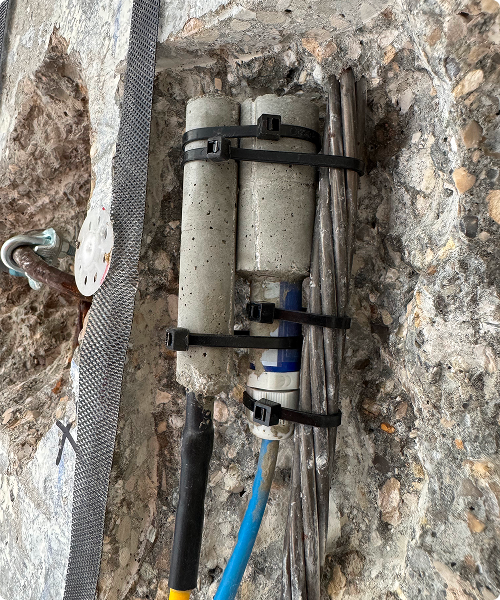
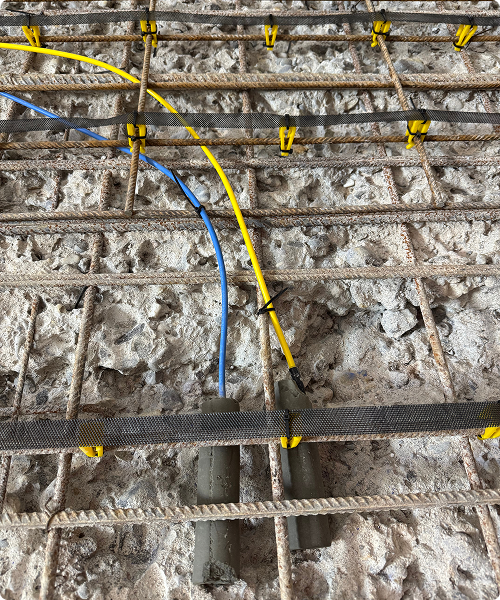
BS-ER-MN-001 reference electrodes are composed of manganese dioxide and designed for long-term integration into reinforced concrete. Pre-encapsulated and pre-wired with a 2.5 mm² (50-strand) blue XLPE-XLPE cable, they can be installed directly during construction without any additional handling.
Their three-dimensional interface, exceeding 250 mm², ensures stable and uniform contact with the concrete matrix throughout the service life. Designed to provide up to 30 years of continuous monitoring of rebar potential, they exhibit low drift—less than 3 mV over 24 hours—ensuring measurement reliability over time.
Key benefits
Up to 30 years of continuous monitoring of the potential of the reinforcements
Long-term integration into reinforced concrete
Pre-coated and pre-wired electrode
Stable and uniform contact with the concrete thanks to a three-dimensional interface larger than 250 mm²
Low drift (< 3 mV / 24 h) for reliable long-term measurements
Compatible with impressed current cathodic protection (ICCP) and galvanic cathodic protection (GCP) systems
Applications
Typical applications: ICCP and GCP systems on reinforced concrete structures (engineering structures, buildings, industrial structures)
| Characteristic | Value |
| Composition | Manganese dioxide |
| Interface | >250 mm²: 3-dimensional |
| Cable | Blue XLPE-XLPE: 2.5 mm²: 50 strands |
| Drift | < 3 mV in 24 hours |
| Expected service life | 30 years |
TI MMO Depolarization Probe: BSSD-TIMMO-001
Depolarization probe designed to verify the effectiveness of cathodic protection in accordance with EN ISO 12696
The BSSD-TIMMO-001 depolarization probes are used to measure the depolarization of steel after the current is turned off. This measurement serves as the benchmark for verifying the effectiveness of cathodic protection in accordance with the EN ISO 12696 standard.
Manufactured from high-purity ASTM B348 Grade 1 titanium with a mixed metal oxide (MMO) coating and an expected service life of 50 years, they are suitable for ICCP and GCP systems on structures where long-term durability is critical. Pre-encapsulated and pre-wired with a 2.5 mm² yellow XLPE-XLPE cable, they are installed at the same time as the reference electrodes.
With an expected service life of 50 years, they are suitable for ICCP and GCP systems on structures where long-term durability is critical.
Key benefits
Reference test to verify the effectiveness of cathodic protection in accordance with EN ISO 12696
Up to 50 years of expected service life
TiMMO probe made of high-purity titanium (ASTM B348 Grade 1) with an MMO coating
Pre-coated and pre-wired with a 2.5 mm² yellow XLPE-XLPE cable
Can be installed at the same time as the reference electrodes
Compatible with ICCP and GCP installations
Applications
Typical applications: ICCP and GCP installations on reinforced concrete structures requiring verification of depolarization
| Characteristic | Value |
| Composition | High-purity titanium ASTM B348 Grade 1 + MMO coating |
| Cable | Yellow XLPE-XLPE: 2.5 mm²: 50 strands |
| Drift | < 3 mV in 24 hours |
| Expected service life | 50 years |
| Compliance | EN ISO 12696 |
Why choose BlueSpine sensors for your construction site?
Ready to install and adaptable to your project
Compliant with EN ISO 12696
BlueSpine sensors have been designed to meet the requirements of the EN ISO 12696 standard, including the color-coding of XLPE/XLPE connection cables: blue for the reference electrode, yellow for the depolarization probe. During installation, quality control is ensured by the Q-Box through a dual-impedance potential measurement, again in accordance with the standard.
Calibration sheet included
Each sensor comes with its own calibration certificate, a document from the DOE that the contractor provides to the project owner upon project acceptance. It certifies that the instrument was in compliance at the time of installation, without requiring any additional action on your part.
Two sensors, complementary roles
The Mn/MnO₂ reference electrode continuously measures the absolute potential of the steel and provides reliable monitoring for up to 30 years. The Ti MMO depolarization probe, meanwhile, measures depolarization after the current is turned off—a benchmark criterion used by the EN ISO 12696 standard to verify the effectiveness of cathodic protection.
Installed in pairs in each instrumented zone, the two sensors cover all the monitoring criteria required to evaluate the system’s performance throughout its service life.
In the BlueSpine line
BlueSpine sensors are part of a comprehensive ecosystem.
BSCP-100 Controller
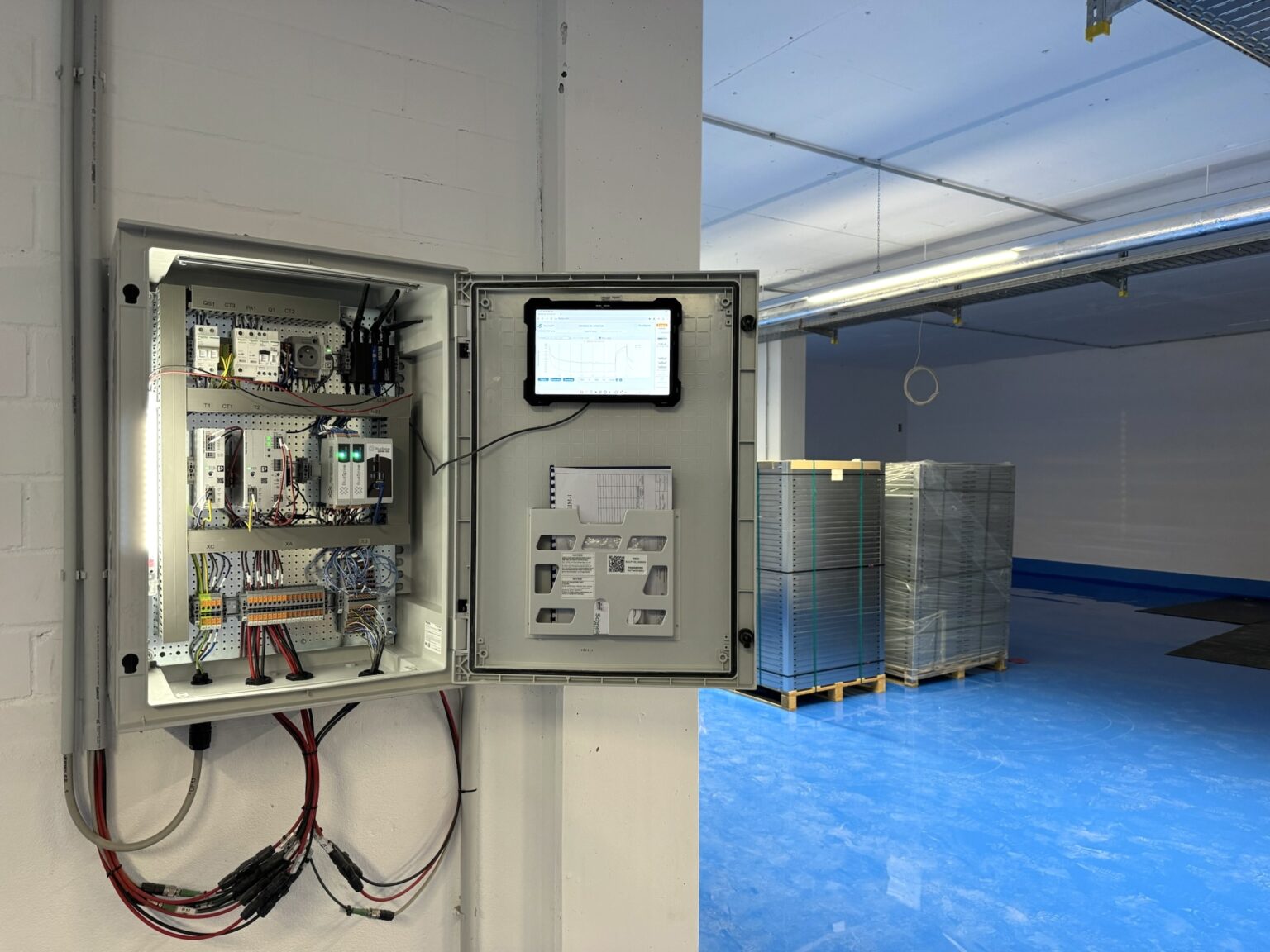
The BSCP-100 controller uses the signals returned by the reference electrodes and depolarization probes to automatically regulate the protective current zone by zone, in real time. The number of measurement channels on the device is tailored to the size of the installation.

Neurona: the remote monitoring platform
Q-Box: the quality control and commissioning tool
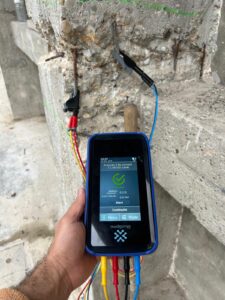
The BlueSpine Q-Box is the only quality control tool used at the cathodic protection site: it verifies electrical continuity, checks the quality of sensor installation, performs zone-by-zone provisional commissioning, and provides the self-test results included in the PAQ.
Q&A
Your questions, our answers
What is the difference between a reference electrode and a depolarization probe?
These are two sensors with complementary roles. The Mn/MnO₂ reference electrode continuously measures the electrical potential of the steel to monitor the system’s performance over time. The Ti MMO depolarization probe is used during the depolarization phases required by the EN ISO 12696 standard. It measures changes in the steel’s potential after the current is turned off, which allows for verification of the cathodic protection performance criteria. Installed as a pair, the two sensors thus cover all of the standard’s monitoring requirements.
Can the cable length be adjusted to suit the site configuration?
Yes, and that’s actually the rule: BlueSpine always adapts the cable length to the site configuration. For sensors located near the junction box, the standard length of 5 m is sufficient. For sensors located farther away, the cable is cut to the desired length. The goal is to avoid any intermediate connections: even when properly made, a cable lug connection introduces a discontinuity in the measurement cable, which can degrade over time.
Do the sensors come with documentation that can be provided upon project acceptance?
Yes. Each sensor comes with its own calibration certificate, which certifies that the instrument was in compliance at the time of installation and forms part of the DOE.
How can you make sure a sensor is installed correctly before it is sealed in concrete?
The BlueSpine Q-Box allows you to verify the compliance of each sensor before sealing it into the finishing mortar. The EN ISO 12696 §8.2 standard requires an installation check by measuring the potential at two different input impedances (10 MΩ and 1 GΩ). The difference between the two values must be less than 10 mV to validate the quality of the installation. If the difference is greater, the Q-Box identifies a problem with the sensor/concrete interface or the connection, which can be corrected before final sealing.
Why pre-coat the sensors when the competition doesn't?
Factory pre-coating serves two essential functions:
- First, it ensures constant contact with the concrete from the moment of installation. Without pre-coating, filling the connection window or drill hole with repair mortar can result in air bubbles or incomplete filling, which compromises contact and, consequently, the potential measurement. Pre-encapsulation provides a calibrated mortar coating that guarantees uniform contact, free from operator variables.
- Second, it prevents the risk of a short circuit between the rebar and the depolarization probe. If the probe comes into direct contact with rebar, the short circuit prevents any depolarization measurement. Pre-encapsulation physically isolates the probe from the rebar as soon as it is installed.
Do you have a cathodic protection project that needs to be set up?
Please provide us with the details of your project: we will guide you and determine the number of sensors, their placement, and how they will be integrated into the cathodic protection system architecture.
Request project references