
Impressed current anodic systems (ICCP)
BlueSpine offers a comprehensive range of anodic systems for impressed current cathodic protection (ICCP) of reinforced concrete structures. Two complementary product families cater to different structural configurations. Activated titanium (TiMMO) anodes, available in several sizes, can be tailored to the needs of each project. The electroconductive carbon coating, meanwhile, is applied directly to the surface for a non-invasive installation.
Up to 50 years
Service life
2 families
Complete systems
EN ISO 12696
Standard compliance
Request a quote
Activated titanium anodes (TiMMO)
TiMMO anodes are inert anode elements. The activated titanium does not corrode under the influence of electric current and guarantees a service life of 50 years. BlueSpine offers three types of TiMMO anodes—discrete anodes, strips, and mesh—to accommodate all types of structure geometries.
Discrete anodes
Pre-encapsulated and pre-wired anodes to reduce drilling and optimize installation time
Ribbons
Titanium MMO continuous strips for large surfaces, installed in shallow grooves
Mesh
Maximum surface coverage for large reinforced concrete surfaces
Pre-encapsulated and pre-wired discrete anodes
Discrete anodes for impressed-current cathodic protection designed to minimize re-drilling and optimize installation time
BlueSpine discrete anodes are activated titanium (TiMMO) anodes that are pre-encapsulated with an insulating micro-mortar and pre-wired at the factory. Installed by drilling, they protect elements with thin concrete cover or deep reinforcement. The risk of short-circuiting with existing steel reinforcement is eliminated upon installation.
The pre-coating ensures optimal electrochemical contact with the concrete from the moment of installation. The XLPE-XLPE copper cables ensure uniform current distribution throughout the protected area. Their high per-unit capacity also reduces the number of anodes and drill holes required to treat the same area.
Key benefits
Elimination of the risk of a short circuit caused by a rebar being struck during drilling
Pre-encapsulated and pre-wired anodes for faster and more reliable installation
Uniform current distribution and protection of larger areas thanks to XLPE-XLPE copper cables with low electrical resistance
Reduction in the number of anodes and boreholes thanks to high capacity per unit
Optimized electrochemical contact between the anode and the concrete
Fast and reliable daisy-chain connections thanks to pre-insulated crimp sleeves
Supply of related connection and injection accessories
Applications
Processing of parts with a thin coating
Protection of deep reinforcement
Applications: beams, columns, structural balconies
Ribbons
Titanium MMO anodic strips for impressed-current cathodic protection, designed to adapt to the structure’s geometry and constraints
BlueSpine strips are continuous strips of titanium MMO sealed into shallow grooves or attached directly to the concrete surface before being covered with a layer of mortar. Their spacing is adjusted according to the design of the installation. Several widths are available to accommodate the rebar density, the aggressiveness of the environment, and space constraints. Transverse titanium distribution strips ensure uniform current distribution across the entire surface.
Key benefits
Installation in shallow grooves (10 to 20 mm) to minimize the impact on the structure
Modular spacing and a variety of widths available to suit every project
Even current distribution across the entire surface thanks to the transverse titanium current-distributing strips
Current density of up to 35 mA/m²
Applications
Treatment of large surfaces requiring uniform current distribution
Typical applications: slabs, walls, and beams with significant cross-sections
Mesh
Titanium MMO anodic mesh providing maximum surface coverage for large reinforced concrete areas
TiMMO mesh provides maximum surface coverage. When incorporated into a covering mortar, they are particularly well-suited for large, flat surfaces such as parking lots, bridge piers, or bridge decks. Available in several mesh widths, they can be adapted to the reinforcement density and the aggressiveness of the environment. Their use is determined during the design phase.
Key benefits
Maximum coverage for treating large areas
Available in various mesh widths
Adapt to rebar density and harsh environments
Applications
Treatment of large flat surfaces
Typical applications: parking garages, bridge piers, bridge decks, and other large surfaces
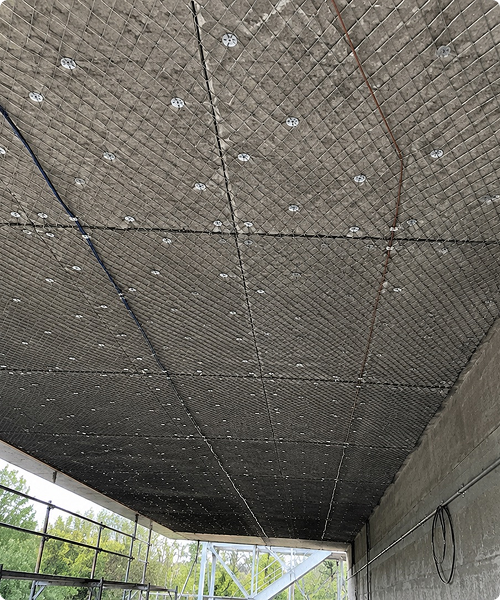
Common characteristics — TiMMO anodes
| Service life | 50 years |
| Substrate | ASTM B 265 Grade 1 titanium |
| Catalyst | Mixed metal oxides (MMO) |
| FHWA Limit Current Density | 110 mA/m² (nominal) · 220 mA/m² (short-term) |
| Compliance | EN ISO 12696 |
| Wiring (discrete anodes) | 2 × pre-wired red XLPE-XLPE 2.5 mm² |
Electroconductive carbon coating
Electroconductive carbon coating for impressed-current cathodic protection applied directly to concrete
BlueSpine electroconductive carbon coating is an anodic system applied directly to concrete, without the need for drilling or leveling mortar to cover the anodic surface. It combines a primary copper-platinum alloy anode with a conductive carbon coating applied by roller to the surface. Compatible with most coatings used in the construction industry, it can be overcoated with acrylic paints, polyurea paints, and other protective finishes.
Technical characteristics
| Service life | 30 years |
| Standard current density | 3 to 10 mA/m² |
| Maximum current density | 35 mA/m² |
| Fire resistance | DIN EN 11925-2-2020, Class D |
| Weather resistance | EN 13687-1 / EN 1504-2 |
Key benefits
Apply directly to concrete without drilling or a mortar backing layer
A non-invasive solution that can be implemented quickly
Compatible with keeping the structure in operation during construction
No significant additional weight is added to the structure
Compatible with most building finishes
Expected service life of more than 30 years
Applications
Structures with a thin concrete cover (15 mm or more)
Treatment of moderate corrosion levels
Typical applications: facades, soffits, conches, and other accessible and minimally damaged cladding surfaces
Why choose BlueSpine anodic systems?
Permanent prevention of corrosion in rebar
Traditional repairs address the visible symptoms, not the underlying cause. On average, the problems recur in less than 5 years—often sooner than before the repair—due to the induced anode effect.
Cathodic protection using impressed current is, to date, the only recognized method capable of halting corrosion of reinforcements for 30 years with carbon-based electroconductive paint, and for up to 50 years with activated titanium anodes, regardless of exposure to aggressive agents (chlorides, carbonation).
Read more
Adapting the anodic system to each configuration
Easy installation and time-saving
Consistent performance throughout the entire service life
Overall project economy
The high specific capacity of the BlueSpine discrete anode—whose active surface area is approximately four times greater than that of comparable anodes on the market—reduces the number of anodes required per zone, and thus the number of drill holes, the volume of materials to be supplied, and installation time. This provides a direct cost-saving benefit on construction sites, which is particularly significant for large-scale projects.
Read more
Made in France
BlueSpine anodes are designed and manufactured in France using European components. The company maintains a controlled supply chain free from significant dependence on non-European sources, in line with the sovereignty requirements of strategic public and industrial projects.
Read more
In the BlueSpine line
Anodic systems are part of a comprehensive ecosystem.
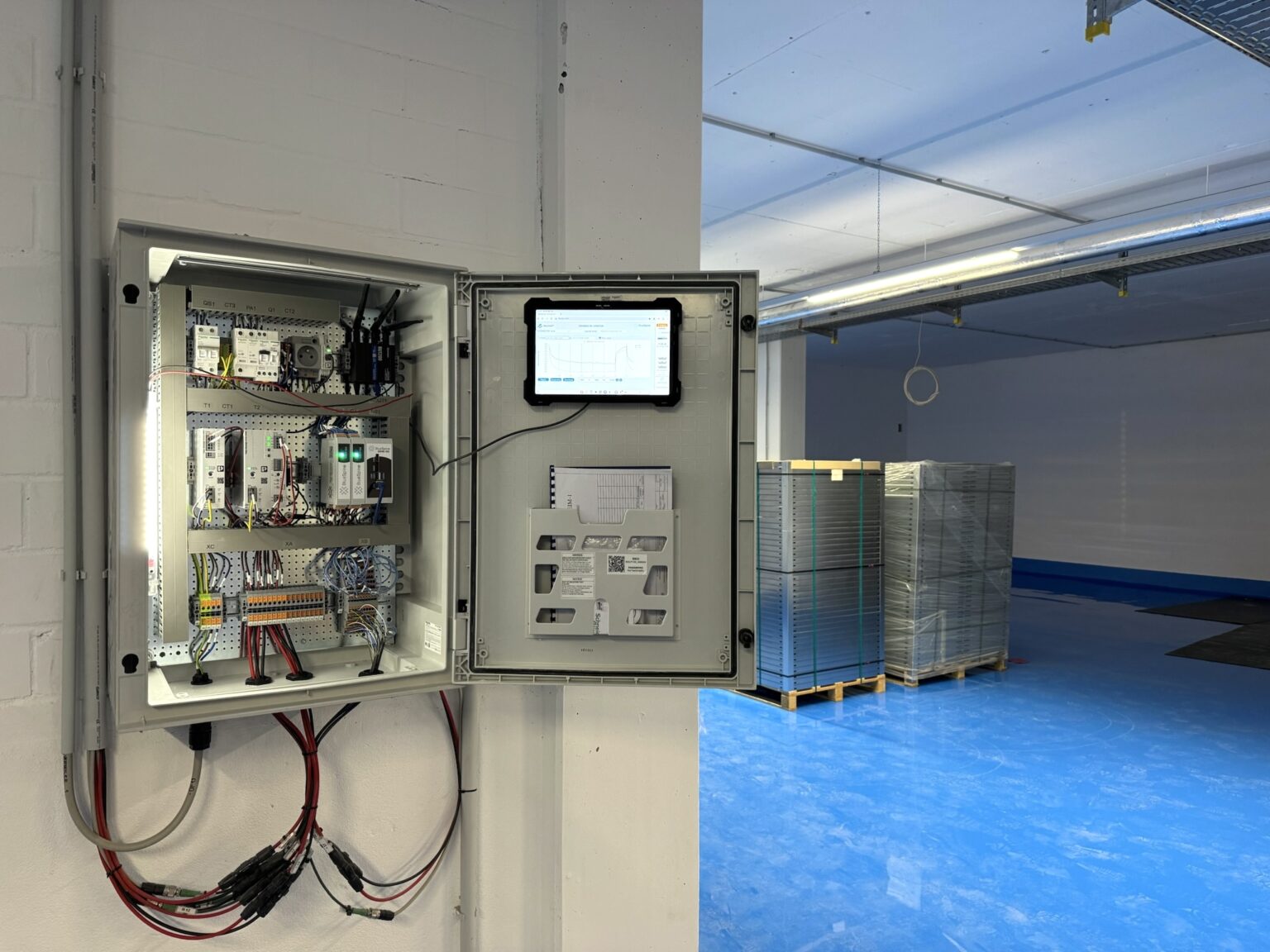
BSCP-100 Controller
The BSCP-100 generates and regulates the protective current distributed across anodic systems. It provides independent zone control, real-time monitoring, and automated generation of standard performance reports.

Neurona: remote monitoring
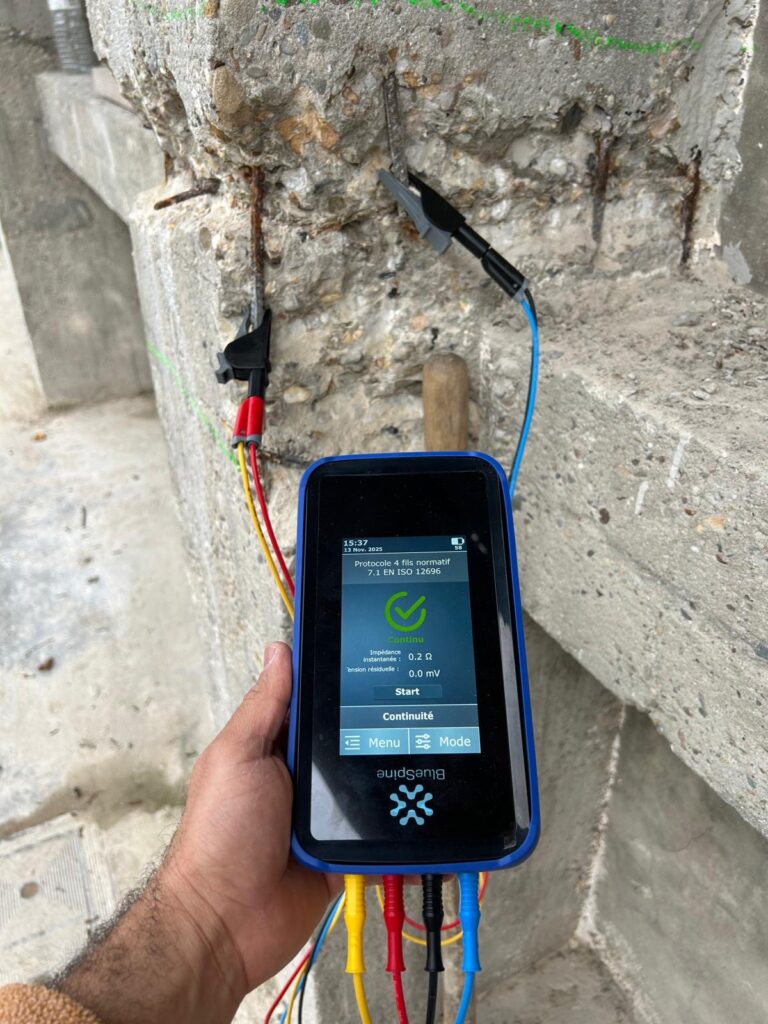
Q-Box: quality control
The BlueSpine Q-Box is the multi-measurement quality control tool used during commissioning: verifying the electrical continuity of the string, injecting current zone by zone, and commissioning the system.
Q&A
Your questions, our answers
How do you choose between discrete anodes, ribbon anodes, and carbon coating?
The choice depends on the structure’s geometry, the density of the reinforcement, the level of corrosion, and operational constraints. Generally speaking, discrete anodes are preferred for linear or thick structural elements, where they can reach the core of the structure and the deepest layers through drilling. Anodes in tape form and electroconductive carbon coating are better suited for surface elements such as balconies or bridge decks. Precise sizing is performed by a specialized engineering firm whose engineers are certified to the EN ISO 15257 standard or an equivalent international standard.
Is a separate titanium anode more expensive than a separate zinc anode on a project-wide basis?
No. In the presence of chlorides, the required protective current is high (10 to 20 mA/m² of steel, according to EN ISO 12696). A zinc sacrificial anode has a low current output: to achieve the same total capacity as a titanium system, approximately four times as many anodes are needed—meaning four times as many drill holes, four times as much material to procure, and installation costs that skyrocket. Titanium remains both more durable and more cost-effective in terms of the project’s overall cost.
How long does it take to install an anodic system?
The duration depends on the structure’s configuration, the number of anode zones, and the chosen format. BlueSpine has designed its equipment to facilitate the installation of its anode systems. Discrete anodes can be installed quickly thanks to factory pre-wiring and crimp connections, and the application of the electrically conductive paint follows the schedule of an industrial painting project.
Do you have a project involving impressed-current cathodic protection?
Please provide us with the available information about the structure (geometry, corrosion condition, diagnostic report if available), and our technical team will help you select the anodic protection system best suited to your configuration.