
In recent years, tragedies involving the collapse of reinforced concrete balconies have become more frequent. A notable example in Angers in 2016 deeply shocked public opinion and raised legitimate concerns about the safety of our buildings.
Vulnérabilité des balcons en béton armé
Balconies, most of which are constructed from reinforced concrete, are particularly vulnerable to aggressive environmental agents such as chlorides and carbon dioxide, which lead to the corrosion of their reinforcing steel . In addition, structural issues may also arise due to design errors or improper placement of reinforcement bars.
A study by the French Construction Quality Agency reveals that in France, at least ten such accidents occur every year, raising concerns about the ability of property managers to ensure the long-term safety and durability of their assets. This issue is becoming even more critical as the housing stock continues to age: more than 60% of multi-family residential buildings were constructed over 50 years ago, suggesting that the frequency of such incidents may increase in the coming years.
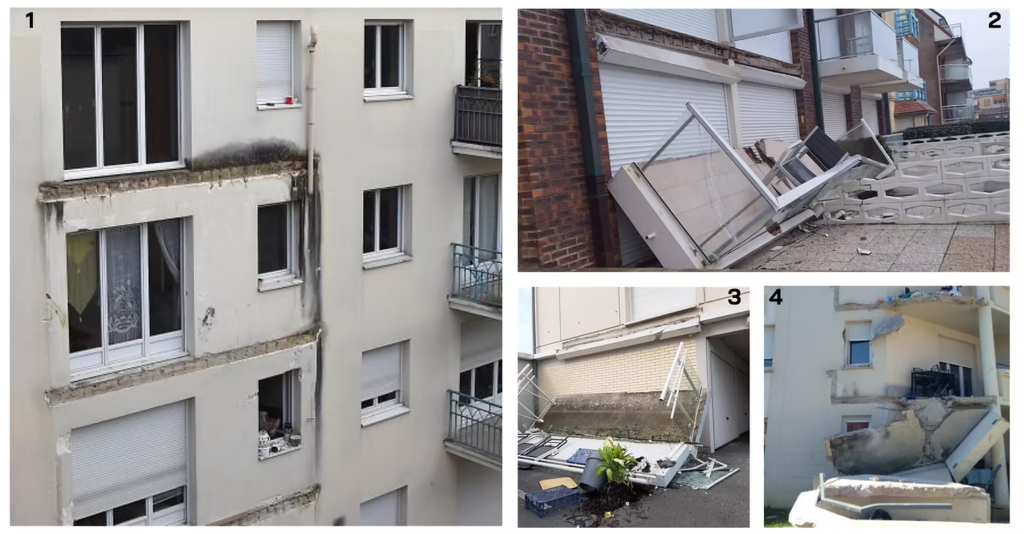
However, such tragedies are not inevitable, and regular inspections enable property managers or social housing providers to allay any concerns regarding the structural integrity of the balconies for which they are responsible, thereby ensuring compliance with regulations. The methodology developed by BlueSpine’s experts enables a precise assessment of the structural integrity of balconies and allows for the recommendation of appropriate measures to ensure their long-term durability.
Problems with reinforced concrete balconies
Most reinforced concrete balconies are anchored to the main structure of the building, often as an extension of the internal floor slab. In these cantilevered balconies, the natural deflection caused by their own weight places a tensile load on the upper part of the slab, where the structural reinforcement is located.
Despite careful calculation and control of deflection, reinforced concrete balconies invariably develop natural cracking at their anchorage points. This cracking, which runs parallel to the support, can be exacerbated by insufficient steel cross-section or incorrect positioning of the reinforcement bars in the vertical section of the slab. The latter situation is frequently observed, as the flexural reinforcement is often placed too low within the vertical section of the slab.
Various types of cracks can develop on a reinforced concrete balcony over time:
- Cracks appearing on the upper surface of the slab and running perpendicular to the support, often found on continuous balconies without expansion joints.
- Cracks in the concrete balustrades, caused by concrete shrinkage and thermal expansion differences between sections that are more or less exposed to the sun.
- Horizontal cracks at the junction between the slab and the balustrade, caused by a lack of lap reinforcement in the concrete pour.
- Vertical cracks, evenly spaced, caused by a lack of horizontal reinforcement or excessive spacing between the contraction joints.
These cracks allow water to seep in and accelerate the penetration of aggressive environmental agents such as chlorides and carbon dioxide, leading to the early onset of corrosion in the reinforcement.
In addition, reinforced concrete balconies are particularly susceptible to the “ top bar effect “, which weakens the quality of the steel-concrete interface and promotes the spread of corrosion. This phenomenon is caused by concrete bleeding, which creates voids beneath the reinforcement bars. The effect is more pronounced for upper bars when multiple reinforcement layers are stacked. In cantilever balconies, the main flexural reinforcement is located in the upper part of the slab and is therefore more likely to be affected.
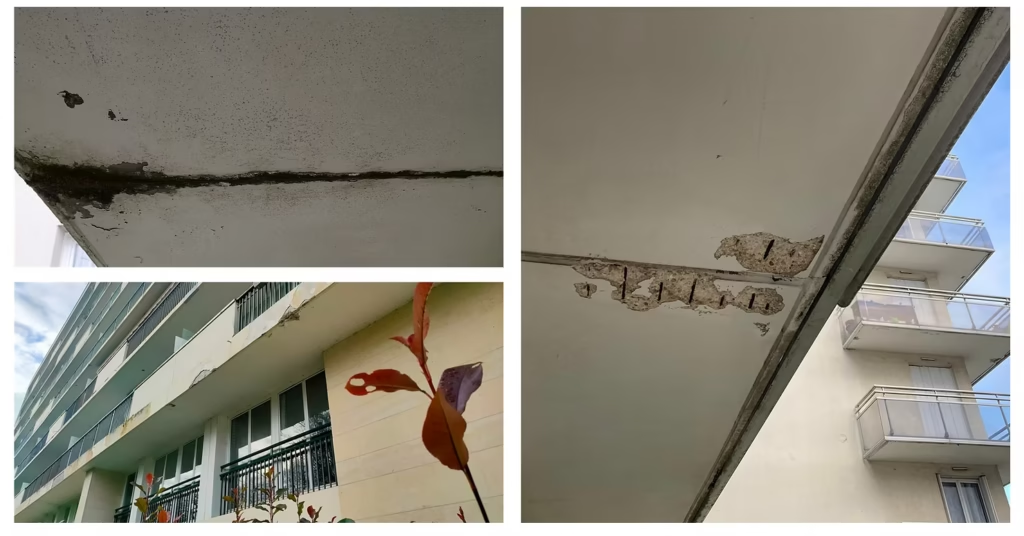
The spread of corrosion inevitably leads to structural deterioration of the reinforced concrete balcony. Expansive oxides initially cause the concrete cover to spall. Although these spalls do not immediately pose a threat to the stability of the balcony, they present a risk of injury to people exposed to falling debris.
Furthermore, corrosion of the steel leads to a reduction in the cross-sectional area of the reinforcement, weakening the balcony’s load-bearing capacity so that it can no longer support the loads for which it was originally designed. A corroded balcony also becomes more fragile due to the reduced ductility of the steel, making it more vulnerable to vibrational stresses such as earthquakes, which exposes occupants to a risk of sudden collapse.
Inspection of reinforced concrete balconies
Cracking, concrete spalling, and the presence of efflorescence beneath the slab should alert property managers to a potential risk of balcony collapse. A condition assessment should then be carried out without delay to determine the cause of the deterioration and evaluate its extent.
This assessment is carried out on a representative sample, selected according to the number of balconies, their configuration, and the structure’s exposure conditions. Initially, a detailed visual inspection is performed to evaluate the extent of the damage and define the scope of repairs as part of the building’s rehabilitation.
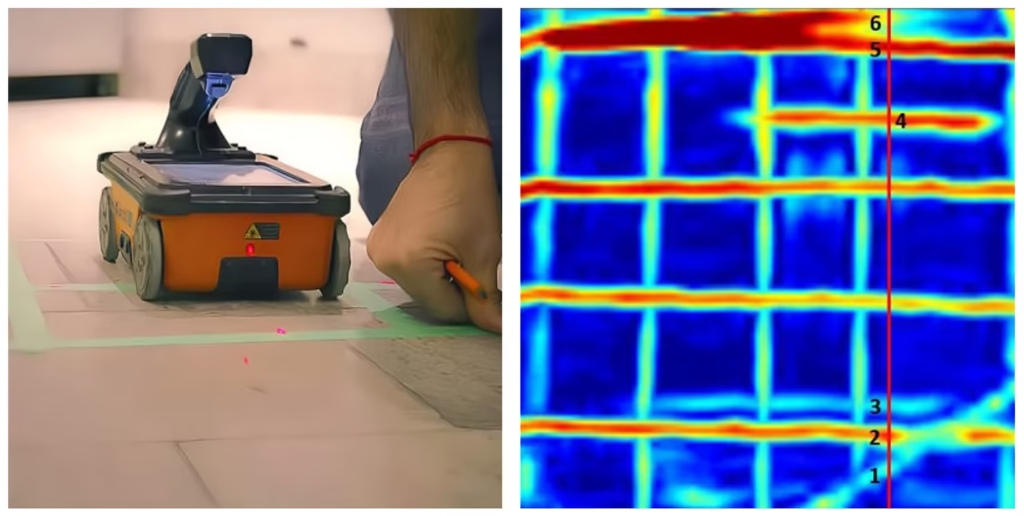
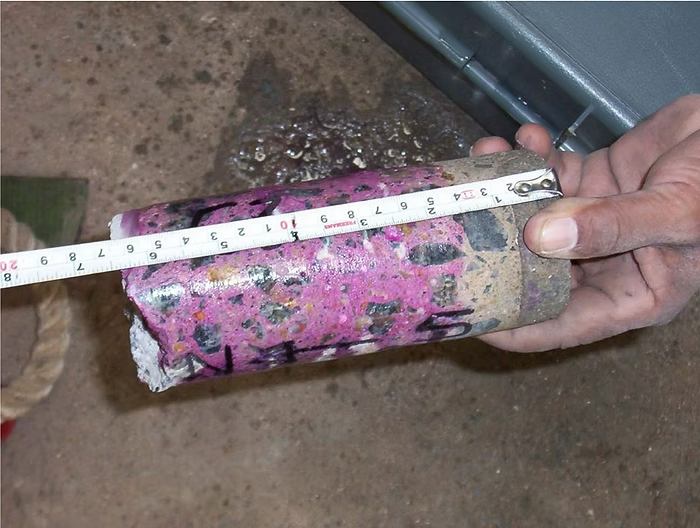
As mentioned previously, an insufficient steel cross-section or improper positioning of the upper reinforcement bars can have a critical impact on the balcony’s load-bearing capacity. It is therefore essential to accurately determine the position, size, and concrete cover of the reinforcement. Various methods are used for this purpose, including non-destructive testing techniques such as cover meters and ground-penetrating radar, combined with destructive investigations.
A structural verification analysis of the balcony’s load-bearing capacity is then carried out to ensure that it remains fit for its intended use. It is essential to account for the effects of corrosion on both the reduction of steel cross-section and the loss of ductility. Based on the calculated load-bearing capacity, BlueSpine’s experts may recommend structural strengthening measures where necessary.
Structural investigation is essential, but it is not sufficient on its own. Indeed, it provides no information about reinforcement corrosion, which remains the primary cause of balcony deterioration and collapse. A specific corrosion assessment must therefore be systematically carried out to identify both the origin and the stage of corrosion, which may vary from one balcony to another depending on exposure conditions.
On-site, reinforcement potential mapping is a reliable method for detecting corrosion activity and distinguishing affected balconies from those that remain intact. Concrete samples are also collected to assess the depth of carbonation and chloride penetration, which are then compared with the minimum concrete cover over the reinforcement.
In cases of advanced corrosion, a curative approach becomes essential to stop its progression and the associated structural damage. Backed by decades of successful application, cathodic protection has proven to be the most effective solution for extending the service life of building assets. Early implementation helps avoid costly future repairs. This technology is now governed by international standards, demonstrating its technological maturity. BlueSpine’s experts hold all the required certifications to design cathodic protection systems based on the findings of the corrosion assessment.
Conclusion
Given the risks associated with the collapse of reinforced concrete balconies, it is crucial to adopt a proactive approach to the assessment and treatment of structural deterioration. Past tragedies serve as a reminder of the urgency of taking action to ensure user safety and preserve the long-term durability of our infrastructure.
A precise assessment of these critical elements, including on-site measurements and laboratory analyses, represents a fundamental step in identifying structural and corrosion-related issues. Based on these findings, our experts can recommend appropriate solutions, such as structural strengthening or the implementation of a cathodic protection system.
Les balcons en béton armé sont exposés à divers désordres tels que fissures, éclats et corrosion des armatures, pouvant compromettre leur stabilité. Cet article détaille les signes d’alerte, les causes de